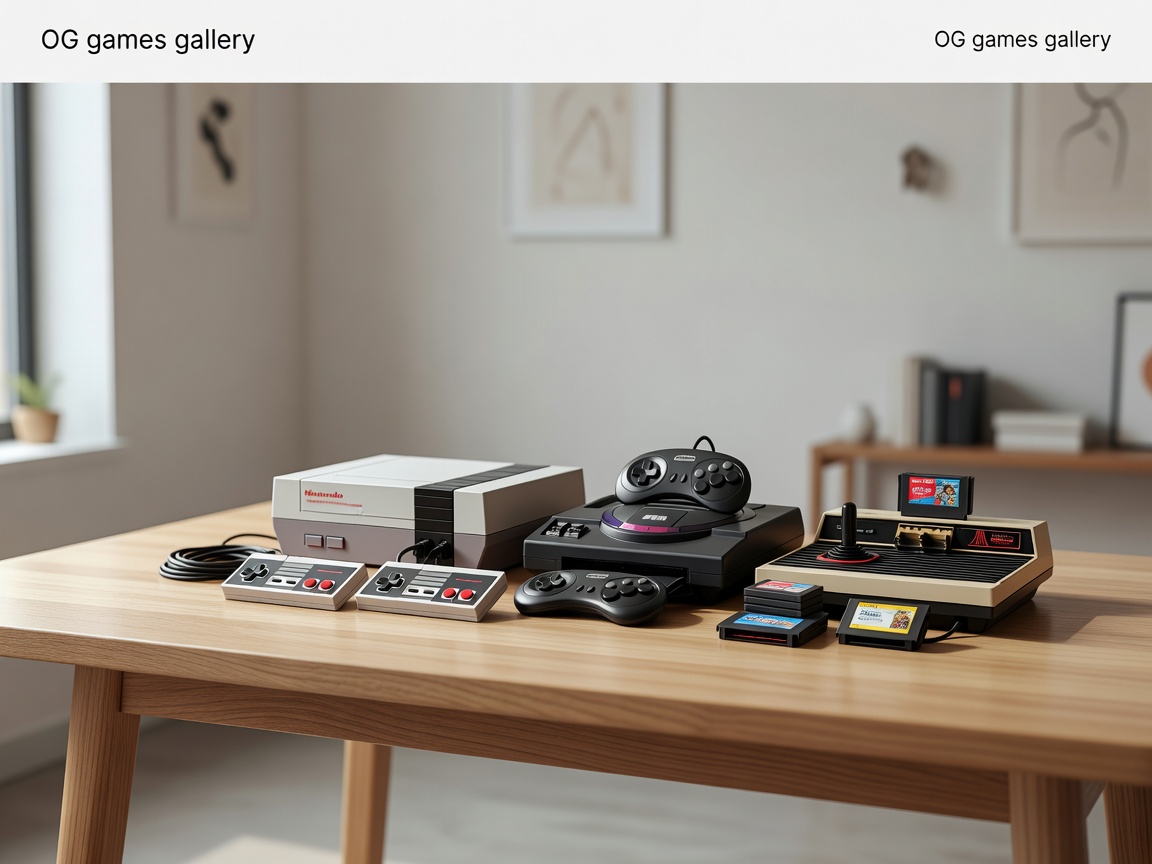
The games that taught the world to play, and the standouts each generation has added since.
What counts as “OG”?
In this museum, OG means the originals: the games that established a genre, a control scheme or a business model that others followed. Many look simple by modern standards, yet you can trace a straight line from their design decisions to the games you play today. Rising difficulty, lives, save files, open exploration and the idea of a mascot character all started somewhere.
The arcade spark
Taito's Space Invaders (1978) turned a screen full of descending aliens into a sensation. Its enemies sped up as you destroyed them, creating tension without a single line of story. Namco's Pac-Man (1980) went further by giving a game a personality: a maze, a hungry hero and four ghosts with distinct chase behaviours that players learned to read.
Nintendo's Donkey Kong (1981), designed by Shigeru Miyamoto, introduced the carpenter then called Jumpman, the character who became Mario. Namco's Galaga (1981) refined the shooter with enemies that swooped and captured your ship. Together, arcades taught three lasting lessons: goals you understand in seconds, difficulty that climbs, and the public high-score table that made competition social.
Games come home
The Atari 2600 (1977) popularised interchangeable cartridges, but a flood of low-quality games contributed to the North American market crash of 1983. Nintendo's Famicom launched in Japan the same year and arrived in North America as the NES in 1985, with strict licensing that helped rebuild trust.
Super Mario Bros. (1985) defined the side-scrolling platformer, while The Legend of Zelda (1986) offered an open world and a battery-backed save inside the cartridge. Tetris, created by Alexey Pajitnov in 1984, became a portable phenomenon when it was bundled with the Game Boy in North America in 1989.
Best games by generation
Curated picks based on documented history and lasting influence. These are not review scores, and we have not assigned ratings.
Decade
1980s
Picks
5
Format
Coin-op & cart
The foundations
Pac-Man (1980): character-led maze chasing
Donkey Kong (1981): the platformer's ancestor
Tetris (1984): the puzzle game everyone knows
Super Mario Bros. (1985): side-scrolling perfected
The Legend of Zelda (1986): exploration and saves
Decade
1990s
Picks
6
Format
CD & cart
The leap to 3D
Doom (1993): the template for first-person shooters
Super Mario 64 (1996): analog 3D movement
Final Fantasy VII (1997): cinematic console RPG
The Legend of Zelda: Ocarina of Time (1998): lock-on combat
Metal Gear Solid (1998): stealth as a genre
Half-Life (1998): story told without cutscenes
Decade
2000s
Picks
6
Format
DVD & online
Worlds and networks
Halo: Combat Evolved (2001): console shooters made mainstream
Grand Theft Auto III (2001): the 3D open city
Metroid Prime (2002): exploration in first person
World of Warcraft (2004): the defining online world
Half-Life 2 (2004): physics as gameplay
Shadow of the Colossus (2005): minimalism and scale
Decade
2010s
Picks
6
Format
Digital
Open worlds and hard lessons
Minecraft (full release 2011): creativity as a platform
Dark Souls (2011): interconnected, demanding design
The Witcher 3: Wild Hunt (2015): consequence-rich quests
The Legend of Zelda: Breath of the Wild (2017): systemic freedom
God of War (2018): a series reinvented
Red Dead Redemption 2 (2018): world detail at scale
Decade
2020s
Picks
5
Format
SSD & digital
The modern canon
Hades (1.0 in 2020): roguelite storytelling
Elden Ring (2022): open-world FromSoftware
The Legend of Zelda: Tears of the Kingdom (2023): building as play
Baldur's Gate 3 (2023): tabletop depth on screen
Astro Bot (2024): a showcase for DualSense haptics
How we chose these picks
Influence: did later games borrow its ideas, controls or structure?
Playability today: does the core loop still make sense to a newcomer?
Availability: can most people play it legally now, through a re-release, collection or subscription?
Variety: each list mixes genres so no single style dominates a decade.
Playing the classics today
You have three broad routes. Official re-releases include the Nintendo Switch Online libraries of NES, SNES and N64 games, the classics catalogue in PlayStation Plus Premium, and publisher compilations. Original hardware gives the authentic feel. Emulation sits in a legal grey area that varies by country; using copies of games you do not own is generally not permitted.
Official re-releases
Legal, convenient and playable on modern TVs
Often include rewind or save-state features
Catalogues change, and subscriptions keep costing
Some classics are tied up in licensing and never return
Original hardware
Authentic controllers, timing and sound
You own the collection outright
Collecting can be expensive and ageing parts fail
Light-gun games need CRT displays to work
Continue the tour
See the machines that ran these games, from 2 KB of RAM to 16 GB.
We use essential storage to run this site and, only with your permission, analytics and functional cookies to understand visits and remember preferences. Read our Cookie Policy.